
Chinese Chess (Xiangqi) vs Chess:
Managing the Whole Board, or Reading When to Cross
The difference becomes clearer when we look at how each game treats structure, Shi (勢), boundaries and the moment to cross.
Xiangqi asks whether the position, boundary and timing are ready for action.
Chess asks how to build and convert a coherent position.
Yet their boards train different kinds of judgement.
Chess and Xiangqi can look like close relatives from the outside.
01
The board already changes the question
Chess and Chinese Chess (Xiangqi) can look like close relatives. Both place opposing forces on a grid, both reward calculation and patience, and both aim to trap the opponent’s king or general. That resemblance makes Xiangqi easy to describe as simply a Chinese version of chess.
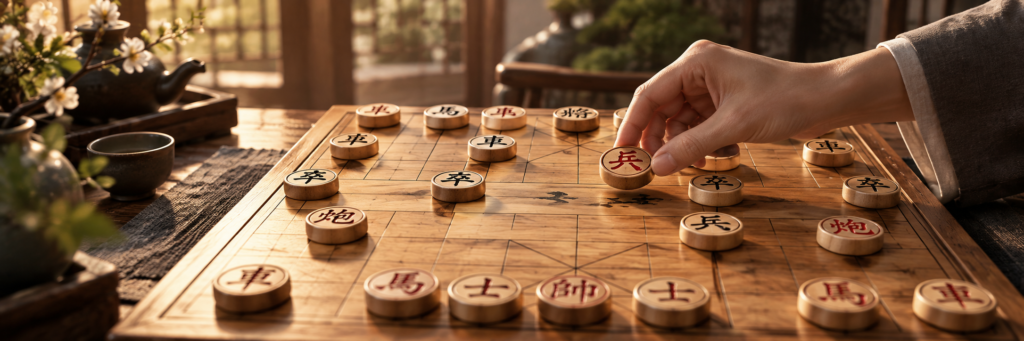
But the board itself changes the problem. Chess unfolds across sixty-four equal squares. Xiangqi contains a river, a palace, pieces that cannot cross certain lines, and a cannon whose power depends on what stands between it and its target. The player is not only calculating moves; the player is continually reading boundaries, position and timing.
Modern chess offers a highly developed framework for study: openings, endgames, structure, space, coordination and king safety. Xiangqi shares the aim of checkmate, but the river, palace and movement rules repeatedly force another question into the calculation: when is it time to cross, and when is crossing too early?
Both games train the mind. What differs is the kind of situation their boards repeatedly ask the player to understand.
02
Structure and boundaries create different maps
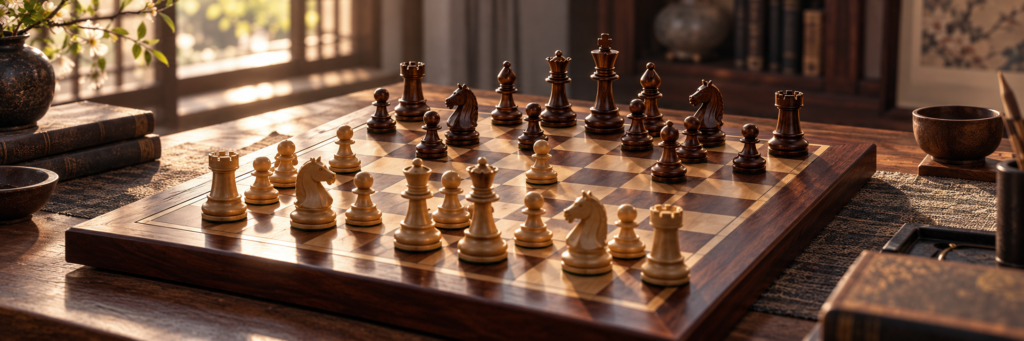
Chess has a rich language for structure. Players study weak squares, pawn formations, open files, development, king safety and long-term coordination. The strength of the game lies partly in how clearly these elements can be analysed. An advantage may begin as a better square, a healthier pawn structure or more active pieces and then become meaningful only many moves later.
Xiangqi also has openings, endgames and extensive theory, but its board makes boundaries impossible to ignore. The palace restricts the general, the river alters the role of several pieces, and the cannon turns intervening pieces into tactical possibilities. This produces a game in which position and timing are tightly linked.
The Chinese idea of Shi (勢) is useful here. Shi is difficult to translate with a single English word. It can suggest the configuration, momentum or potential already present in a situation. A player may not have won material, yet the position can already be difficult for the opponent because the rooks, cannons and soldiers have created pressure in the right places.
Shi is therefore not the opposite of calculation. It is what calculation is trying to read: whether a move is supported by the position, or whether it is forcing an attack before the conditions are there.
Shi is not the opposite of calculation.

03
Both calculate, but not always the same thing
Both games demand foresight. A careless move can lose immediately, and strong players in either tradition calculate multiple variations before committing. Yet the board directs that calculation differently.
In chess, a common strategic sequence is to improve the structure, identify a weakness, exchange or advance, and turn a small advantage into something that can be carried into the endgame. The position often rewards accumulated correctness: pieces become better coordinated, weaknesses become harder to defend, and an advantage gradually becomes visible.
Xiangqi can change speed more abruptly. A rook reaches an open line, a cannon gains the right screen, or a soldier crosses the river and suddenly the distance to the general feels much shorter. This does not make Xiangqi more impulsive. It means that a boundary has changed the geometry of the position.
A useful metaphor is that chess often feels like managing an entire landscape, while Xiangqi can feel like negotiating across a river while deciding when the crossing itself will transform the situation.
04
Shi is not simply “having the advantage”
In chess, advantage is often described through material, structure, space, time and king safety. Many of these can be discussed with considerable precision. Xiangqi contains the same kinds of considerations, but Shi often draws attention to something slightly different: whether the position is ready to support action.
A cannon on the central file or a rook controlling the river may not immediately win a piece, yet the opponent’s choices can already be narrowing. On the other hand, attacking the palace without enough support may scatter one’s own forces. Having more pieces near the target is not the same as having a position that can carry the attack.
This is why timing matters so much. Acting before the position has formed can turn initiative into exposure. Waiting after the position is ready can give that initiative back. The skill is not simply calculating whether a move works in isolation, but judging whether this is the moment in which the move belongs.
The skill is not simply knowing whether a move works, but whether this is the moment in which it belongs.
A possible move is not automatically a timely move.
That distinction reaches beyond the board without needing to turn Xiangqi into a management metaphor. The game repeatedly makes one experience the difference between ability and timing. A move may be possible, clever and even aggressive, yet still be wrong because the situation is not ready for it.
05
Boundaries can sharpen judgement
For people who are already comfortable with planning, Xiangqi introduces a useful complication: not every part of the board is equally available, and not every advance can be reversed easily. The river, the palace and the movement of individual pieces force the player to work with constraints rather than imagine an open field.
This is one reason the game can resonate with traditional Chinese ways of thinking about situation and response. Good judgement is not only a matter of knowing what one wants to do. It also depends on knowing where one stands, what the present configuration allows, and whether the moment calls for advance, restraint or repositioning.
Chess develops remarkable discipline in calculation, structure and execution. Xiangqi adds its own distinctive pressure: calculate, but also read the boundary; prepare, but also recognise the moment; advance, but know what changes once the river has been crossed.
The point is not to choose which game is more profound. They simply place intelligence under different conditions, and those conditions train different habits of attention.
06
At a glance
| Chess | Chinese Chess (Xiangqi) | |
|---|---|---|
| Board | Sixty-four equal squares | River, palace and movement boundaries |
| Typical focus | Structure, coordination, space, king safety | Boundaries, cannon lines, river control, timing |
| Core question | How can I improve and convert the position? | Is this the moment to hold, reposition or cross? |
| Common pattern | Build and convert an advantage | Create Shi, then recognise the moment to act |
| Tempo | Advantages often accumulate over time | Crossing a boundary can change the position quickly |
| Often cultivates | Calculation, structure and long-term execution | Calculation, timing, limits and reading Shi |
Chess and Xiangqi both reward intelligence, patience and disciplined calculation. Their difference lies less in which one is harder than in what their boards make impossible to ignore.
Chess asks the player to build a coherent position and make an advantage work across the whole board. Xiangqi asks the player to do that while continually reading limits, momentum and timing. The river is therefore not merely a feature of the board. It becomes a recurring lesson in judgement: before crossing a line, understand what the position will become once you do.
Before crossing a line, understand what the position will become once you do.