
Tai Chi vs Modern Exercise:
Cultivation Through Movement
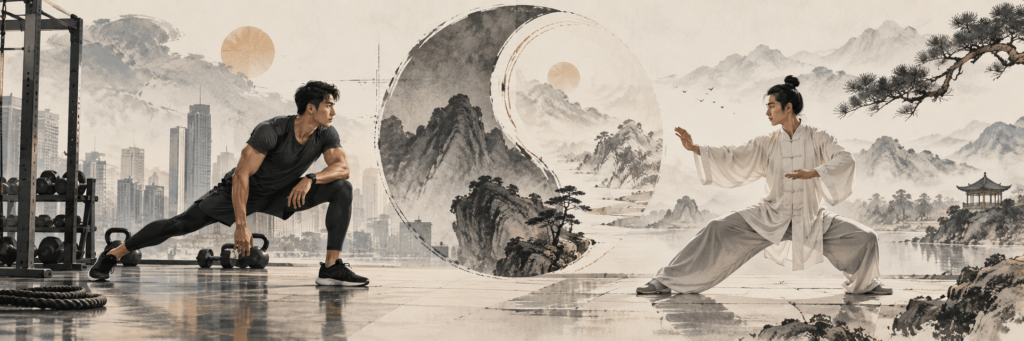
Tai Chi and modern exercise can both build physical capacity.
Yet they organise movement around different questions.
Modern exercise asks what the body can do better.
Tai Chi asks whether the body can remain connected while conditions change.
The difference becomes clearer when we look at slowness, softness, unnecessary force, and the transitions between one movement and the next.
01
First, separate the goals
Tai Chi is often introduced through what it looks like: slow movement, controlled breathing and a sequence performed with unusual calm. From the outside, it can resemble gentle exercise, mobility work or a moving form of relaxation. That description is not wrong, but it misses the centre of the practice.
Modern exercise often asks how the body can become stronger, more mobile, more stable or more efficient. Tai Chi also develops physical ability, yet it places another question inside the movement: can strength and softness, opening and closing, advancing and yielding remain coordinated as the body changes from one position to the next?
In contemporary fitness, progress is often visible and measurable. Tai Chi belongs to a different historical framework, shaped by ideas such as Yin and Yang, substantial and insubstantial, opening and closing, intention and Qi. Rather than training isolated abilities, it asks how those qualities remain connected while the body is moving.
The transition matters as much as the posture. Weight has to move without the upper body becoming rigid; an advance contains the possibility of retreat; a yielding movement can prepare the next expression of force.
02
Tai Chi uses a different map of the body
Modern training is grounded in anatomy, physiology and training science. It can identify which muscles are working, what load is being applied, how recovery should be managed and what adaptation is expected. This clarity is one of its great strengths.
Tai Chi uses another map alongside the physical one. Yin and Yang describe not two static halves, but a relationship in which qualities continually transform into one another. Applied to movement, this becomes practical: one leg is more substantial while the other becomes lighter; one side opens as another gathers; an outward action remains connected to a return.
Traditional teaching also uses the language of Qi. Here, Qi should not be reduced to a mysterious substance. In practice, the term helps organise attention around breath, tension, alignment, continuity and the felt quality of movement. A raised chest, tight shoulders or a rushed step may be described as Qi rising or scattering; a more grounded posture and continuous movement may be described as Qi settling and flowing.
Whether or not a modern reader uses that vocabulary personally, the training principle is clear: movement should not be produced by one tense part of the body while the rest disconnects.
03
Slowness reveals unnecessary force
Tai Chi often looks easy because it is slow. In practice, slowness can make the exercise more demanding because there is less momentum to hide behind. When movement is fast, a person can rush through imbalance or compensate with strength. When movement slows, those habits become visible.
The slowness is not the point. It is what the slowness allows us to see.
The shoulder tightens before the hand moves. The chest lifts before a step. Weight shifts too early. The body tries to complete the shape before the transition is ready. Tai Chi uses slowness to expose these moments rather than to make the practice gentle for its own sake.
A common training sequence is to establish alignment, distinguish substantial from insubstantial, allow movement to originate through the legs and waist, and let the hands follow rather than lead with isolated force. The traditional phrase “use intention rather than force” is often misunderstood here. It does not mean that strength disappears. It means that strength is organised rather than immediately imposed.
Strength is not removed; it is organised.
Modern exercise may ask whether the body can generate more force. Tai Chi asks an additional question: how much unnecessary force appears before the useful force even begins?

04
Softness is a method, not the absence of strength
In everyday English, “soft” can sound like the opposite of strong. In Tai Chi, softness has a more technical meaning. It refers to remaining responsive enough that force can change direction rather than becoming trapped in rigidity.
Softness is a method, not the absence of strength.
This is the logic behind the familiar phrase “use softness to overcome hardness.” The principle is not passive surrender. If the body meets every pressure with immediate tension, it loses options. If it can remain organised without becoming rigid, pressure can be redirected, absorbed or returned from a better position.
That is also why Tai Chi pays close attention to opening and closing, advancing and yielding. These are not competing choices. They are phases within one process. A movement that only advances eventually becomes stiff; a movement that only yields has no structure. Skill lies in changing from one to the other without losing the centre.
For people accustomed to solving problems by applying more effort, this can be an unfamiliar kind of training. The challenge is not whether one can push harder, but whether one can stop adding force where force is no longer helping.

05
Movement can train how we respond to change
The benefits of strength training, mobility work and yoga are substantial. They can restore physical capacity, reduce the effects of sedentary life and help people feel at home in their bodies again. Tai Chi does not need to replace any of them.
Its distinctive contribution is the way it treats change itself as the training environment. Every step transfers weight. Every turn changes direction. Every opening contains a closing. The practitioner repeatedly experiences the need to stay organised while the conditions are moving.
This makes “not scattering” a useful way to understand the practice. A person may be physically strong yet become tense whenever balance shifts or pressure appears. Tai Chi trains another possibility: remain grounded enough to change without collapsing, and soft enough to adapt without losing structure.
In traditional terms, this is where movement and self-cultivation meet. The form is not only something the body performs. It becomes a way of noticing how quickly we stiffen, rush, overreach or resist transition, then practising a different response while the movement is still happening.
06
At a glance
| Modern Exercise | Tai Chi | |
|---|---|---|
| Primary framework | Training science, anatomy, performance | Yin-Yang, substantial/insubstantial, intention and Qi |
| Typical focus | Strength, mobility, fitness, posture | Coordination, continuity, balance and change |
| Role of repetition | Create adaptation through load or practice | Refine transitions and remove unnecessary force |
| Meaning of slow/soft | Often lower intensity or recovery | A method for seeing tension and keeping movement adaptable |
| Core question | What can the body do better? | Can the body stay connected while conditions change? |
| Often cultivates | Capacity and physical performance | Groundedness, responsiveness and integrated movement |
Tai Chi is not valuable because it is slower than modern exercise, and modern exercise is not limited because it is more measurable. They simply begin with different priorities.
One develops the body’s capacity in clear and effective ways. Tai Chi places capacity inside a moving relationship between strength and softness, stability and change, intention and action. Its deeper lesson is not to avoid force, but to use less of the force that comes from tension, habit or haste.
The form may look calm from the outside. What it is really training is the ability to remain coordinated while nothing stays still.
What Tai Chi trains is the ability to remain coordinated while nothing stays still.