
Mindfulness vs Chinese Seated Practice (Dazuo):
Two Traditions of Stillness
Mindfulness and Dazuo can look almost identical from the outside.
Yet they are not cultivating the same kind of stillness.
Mindfulness trains awareness.
Dazuo asks whether the whole person can settle.
The difference becomes clearer when we look at how each tradition understands the body, breath, mind, and the purpose of sitting.
01
First, separate the two practices
In popular use today, mindfulness usually refers to practices such as following the breath, noticing thoughts and sensations, and returning attention to the present without judgment. It is widely used in contemporary psychology, wellbeing, and stress management.
Dazuo literally refers to seated practice. Within Chinese Buddhist and Daoist traditions, it developed as part of a broader path of self-cultivation rather than simply as a technique for relaxation.
The posture is only the visible form. What matters is what begins to change while a person sits: whether the body releases unnecessary tension, whether the breath becomes steadier, whether the mind becomes less scattered, and whether Qi is able to settle rather than continually rise or disperse.
The comparison is not that one tradition is deeper than the other. They begin with different questions.
Mindfulness asks:
How do I notice what is happening without being carried away by it?
Dazuo asks:
How can body, breath, mind, and Qi become more settled and coordinated?
02
Different traditions create different maps
Modern mindfulness, particularly in its contemporary secular forms, has developed a clear language around attention.
Notice the breath. Recognise a thought. Allow it to pass. Return to the present.
Its strength lies partly in that clarity. The practice is accessible, the instructions are direct, and the benefits can be described in familiar terms: greater focus, less automatic reaction, and a better ability to notice what is happening as it happens.
Dazuo developed within a different understanding of the person.
Body and mind are not treated as entirely separate systems, and the condition of the breath and Qi forms part of how a person’s overall state is understood.
Restlessness, shallow breathing, physical tension, mental agitation, or an inability to settle are therefore not approached only as problems of thought. They can also be signs that the whole system has not yet come to rest.
This is why Dazuo is difficult to describe simply as “managing the mind.”
Its focus is broader: not only becoming aware of experience, but allowing the whole person to settle within it.
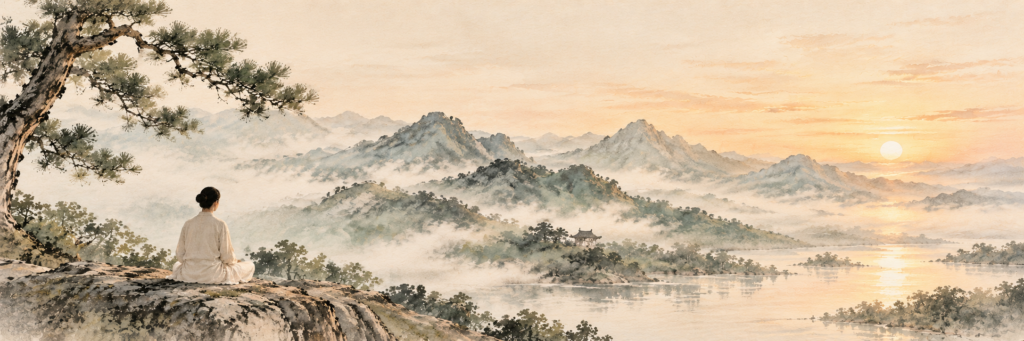
03
Similar methods, different centres of gravity
The two practices can look almost identical.
Both may involve posture. Both may use the breath. Both may ask us to stop chasing every thought that appears.
But the emphasis is different.
A familiar mindfulness process might be:
Rest attention on the breath → notice a thought → do not follow or judge it → return to the present.
Awareness itself is being trained.
A simplified Dazuo process might look like:
Settle the posture → allow the breath to become more natural → let attention gather with the breath → allow the body and mind to become progressively quieter.
Thoughts may still appear. They do not necessarily need to be examined or managed one by one.
The aim is less about monitoring every movement of the mind and more about creating the conditions in which agitation can gradually settle.
One useful image is water.
Mindfulness helps us notice the ripples.
Dazuo also asks whether the water itself can become still again.
04
A Different Understanding of Stillness
In everyday language, stillness often means the absence of interruption: fewer notifications, fewer thoughts, more concentration.
Within Dazuo, stillness is not simply the absence of activity. It is closer to gathering and restoring.
Much of daily life draws attention outward: responding, deciding, speaking, performing, anticipating what comes next.
Sitting reverses that direction.
For a period of time, nothing needs to be produced. The body no longer needs to keep pushing forward. The breath is allowed to find its own rhythm.
This is why the quality of the practice is not judged only by whether the mind became quiet.
Other questions matter as well:
Has the breath become deeper and easier?
Has unnecessary tension released?
Does the body feel more grounded?
Is attention steadier without being forced?
A blank mind does not necessarily mean a person has settled.
Stillness, in this tradition, is not emptiness for its own sake. It is a state in which the person becomes less scattered.
05
Awareness and settling work at different layers
For people living with constant information, pressure, and responsibility, mindfulness can be extremely useful.
It helps make patterns visible. A person begins to notice how quickly attention is pulled away, how thoughts become reactions, and how easily one moment is replaced by the next.
But awareness does not always change the state underneath it.
Someone may know perfectly well that they are anxious, depleted, or overstimulated and still find it difficult to settle.
Dazuo begins from the idea that understanding a state and changing a state are not always the same thing.
The practice therefore gives attention not only to what a person sees in the mind, but also to the condition from which that seeing takes place.
Is the breath still hurried?
Is the body still braced?
Is attention clear, or merely watchful?
Has the person actually become more settled?
The distinction is not about choosing one practice over the other. It is about recognising what each one places at the centre.
Mindfulness develops the ability to be aware of the present moment.
Dazuo develops the capacity to remain more settled within it.
One works strongly through awareness.
The other brings awareness back into the wider relationship between body, breath, mind, and Qi.
06
At a glance
| Modern Mindfulness | Chinese Seated Practice (Dazuo) | |
|---|---|---|
| Main tradition | Contemporary attention training and psychology | Buddhist and Daoist traditions of self-cultivation |
| Primary focus | Attention and awareness | Body, breath, mind, and Qi |
| Core question | How do I become more present? | How do I become more settled? |
| Common approach | Notice thoughts and return to the breath | Settle the body and breath, allowing the whole state to quieten |
| Understanding of stillness | Less distraction and reactivity | Gathering, restoring, and becoming less scattered |
| Commonly sought result | Greater focus and awareness | Greater steadiness and integration |
Stillness can mean more than becoming quiet.
It can also mean returning to a condition in which the body is no longer braced, the breath is no longer hurried, and attention does not need to be held together by force.
That is where Dazuo begins to differ from simply sitting still.
It is not only a way of observing the moment.
It is a practice of becoming more settled within it.