
The Chinese Game of Go (Weiqi):
See the Whole Board Before Playing the Next Stone
Go can look like a simple game of placing stones.
Yet its difficulty lies less in the stones than in the judgement of the whole.
A group survives through liberties, connection and space.
A strong player must know not only where to act, but what can be left alone.
The difference becomes clearer when we look at Qi, local fights, initiative and the discipline of letting go.
01
Go is not primarily a game of capturing
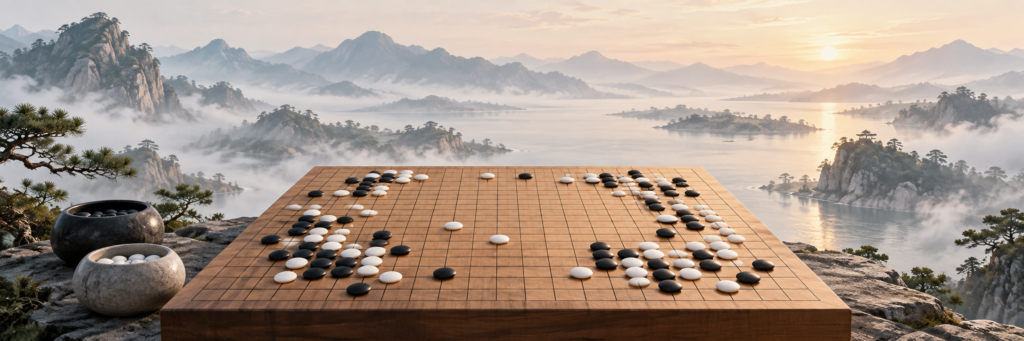
Go, known in Chinese as Weiqi (圍棋), is an ancient board game built around surrounding, connecting and creating living space. Two players take turns placing black and white stones on an almost empty grid. There is no king to protect, no army waiting at the start and no single piece with special powers. That emptiness is precisely what makes the game demanding.
In chess, the objective is easy to recognise: trap the opponent’s king. Go works differently. It has captures too, but capturing is not the first organising principle. The player is trying to build living groups, secure territory and create positions that remain viable across the whole board.
Nothing tells the player where the centre of action should be. A move may strengthen one group, claim influence elsewhere, answer an immediate threat or simply waste time in a local battle that no longer matters. Because the board begins almost empty, value has to be judged before it becomes obvious.
Go therefore trains a question that reaches beyond calculation: before playing the next stone, can you still see the whole board?
02
In Go, Qi has a precise meaning
The word Qi (氣) appears in Go, but here it has a technical meaning before it has any philosophical one. In English, these points are usually called liberties: the empty points directly adjacent to a stone or connected group. When all of a group’s liberties are removed, the stones are captured.
In Go, Qi is concrete before it is philosophical.
That rule is simple, but it changes how the entire board is read. A group may look large yet be vulnerable because it has too little room to live. Another group may contain fewer stones but remain strong because it has space, connection and enough liberties.
This is why it is important not to turn Qi in Go into a vague idea of “energy.” On the board, the condition is concrete: a group either has liberties or it does not. Only after understanding that technical meaning does the wider metaphor become useful.
A position can become overextended because too many stones are committed to something that cannot be made alive. Strong play may require adding support, creating space, connecting outward or abandoning a group that is consuming more moves than it is worth. The difficult question is often not how to save everything, but whether everything should be saved.
03
A local victory can hide a larger loss
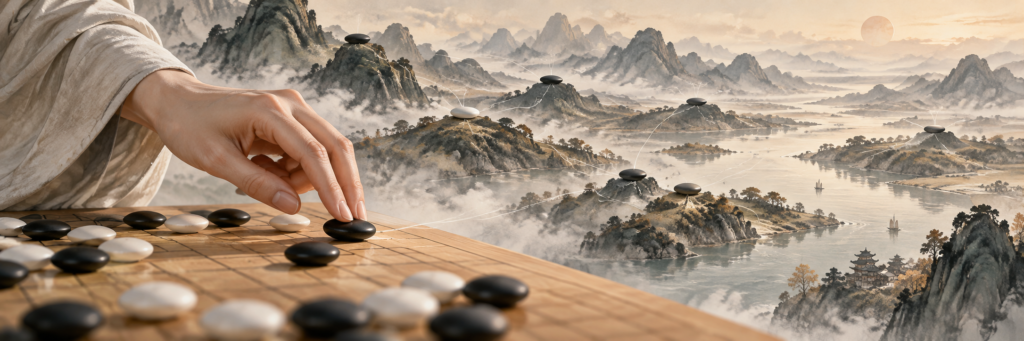
One of Go’s most persistent lessons is that the most dramatic part of the board is not always the most important. A local fight creates urgency. Stones are threatened, captures are possible and the next move feels obvious. Yet while both players concentrate on one corner, the rest of the board continues to hold value.
A local victory can hide a larger loss.
This is what “seeing the whole board” really means. It is not simply thinking far ahead. It is the ability to compare the importance of several situations at once.
Sometimes a local group must be defended because it is genuinely in danger. At other times, answering every attack only allows the opponent to determine where the game will be played. A player can win the argument in front of them and still lose the larger direction of the game.
The lesson is particularly visible in Go because there is no single king drawing every line of play toward one target. Several groups can be developing simultaneously, each with different degrees of strength, vulnerability and future potential. Judgement depends on knowing which one matters now.
04
Initiative means more than moving first
Go has another important concept: sente, usually translated as initiative. A move has sente when it demands an answer and allows the player to move elsewhere afterwards. Its opposite, gote, leaves the initiative with the opponent.
This creates a subtle kind of discipline. A move can gain something locally yet still be too small if it costs the player the chance to move first in a more important area. Conversely, a quiet move that seems to achieve little immediately can be powerful if it preserves initiative and shapes what the opponent must respond to.
The strongest move is therefore not always the most aggressive one. Sometimes it is the move that keeps options open.
The strongest move is not always the most aggressive one.
This is closely related to knowing when not to respond. The board constantly tests whether a player is acting from judgement or merely from the discomfort of leaving something unfinished.
Not every threat deserves an answer. Not every stone deserves rescue.
Go rewards the ability to stop defending yesterday’s investment when the larger board has already moved on.

05
The empty board turns change into something visible
Go is often connected with Chinese philosophical language because its structure makes relationships and change unusually visible. Advance and restraint, connection and separation, taking and giving up all appear directly on the board. But those ideas become meaningful only because the stones keep forcing concrete decisions.
A shape either has enough room to live or it does not. A territory is secure or still only potential. Initiative is retained or surrendered. A local fight is important or it is consuming moves that should be spent elsewhere.
This makes the game a powerful exercise in judgement rather than a collection of abstract principles. The player has to keep asking what the position has become, not what it was five moves ago. A stone that was once urgent may now be expendable; an empty part of the board that once seemed distant may have become the largest opportunity.
The deeper habit Go develops is therefore not endless calculation. It is the ability to update one’s understanding while the whole situation is changing, and to resist spending attention simply because something is emotionally difficult to leave alone.
06
At a glance
| Chess | Go / Weiqi | |
|---|---|---|
| Starting board | Pieces begin in fixed positions | The board begins almost empty |
| Primary objective | Trap the opponent’s king | Build living groups and territory |
| Basic language | Material, structure, king safety | Liberties (Qi), connection, life, territory, influence |
| Common temptation | Tactical gain or attack | Winning a local fight |
| Deeper challenge | Convert advantage into a complete win | Avoid losing the whole board through local reactions |
| Often cultivates | Calculation and execution | Whole-board judgement, initiative and knowing when not to respond |
Go does not teach that local battles are unimportant. Some must be fought, and some stones must be saved. Its discipline lies in refusing to assume that the nearest problem is automatically the largest one.
The empty board keeps asking the player to compare, update and let go. Does this group still have enough liberties? Is this fight worth another move? If I answer here, what opportunity disappears elsewhere?
That is why seeing the whole board matters before playing the next stone. The strongest move is not always the one that wins the immediate exchange. Sometimes it is the one that keeps the position alive, preserves initiative and leaves room for what has not yet happened.