
Chinese Tea vs Western Wine:
Opening a Room, or Gathering Qi
The contrast becomes clearer when we look at terroir, repetition, social rhythm, and what each tradition asks the drinker to notice.
Chinese tea invites attention to gather inward.
Wine often opens the experience outward.
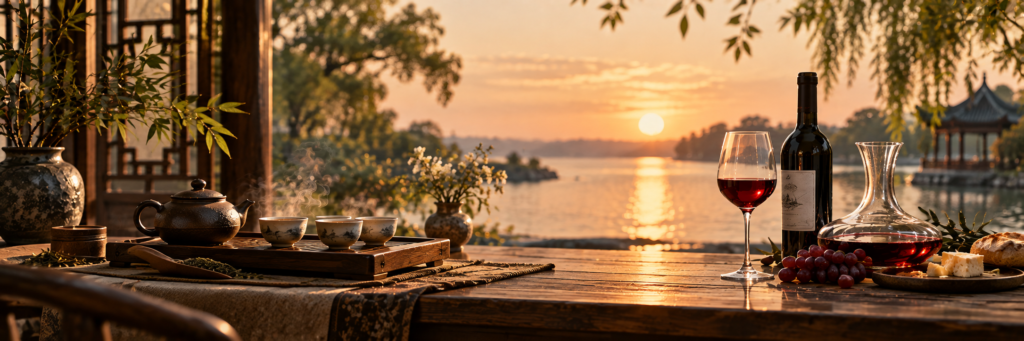
Wine and Chinese tea can both turn drinking into a deliberate experience, but they often lead attention in different directions.
01
First, compare like with like
Chinese tea and Western wine may seem like an unusual comparison. Yet both can turn drinking into something more deliberate. A bottle of wine may invite attention to terroir, vintage, aroma and the people around the table; a Chinese tea session may draw attention to mountain, water, temperature, repeated infusions and, eventually, to the condition of the person drinking.
British afternoon tea might seem like the obvious Western counterpart to Chinese tea, but culturally, wine is often the more revealing comparison. A bottle taken seriously is not consumed simply because someone is thirsty. Region, grape, ageing, glassware and pairing become part of the experience. Gongfu tea can work at a similar level: water is heated, vessels are warmed, leaves are measured, and the same tea is brewed repeatedly.
The difference is not simply alcohol versus tea. It is the direction in which the experience often moves. Wine frequently opens a gathering outward; Chinese tea can draw attention inward. That does not make one more refined than the other. It means each tradition can organise taste, time and social space in a different way.
The repetition of a tea session changes the question from “Is this good?” to something more subtle: what changes when I stay with the same thing for longer?
02
Two traditions, two maps of attention
Wine has a sophisticated language of terroir. Soil, climate, slope, grape, fermentation and ageing all help explain what appears in the glass. Tasting then gives the senses a structure: colour, aroma, body, acidity and finish. Chinese tea has its own equally detailed geography. Mountain, altitude, tree age, season, processing, storage and water all shape the cup.
Traditional tea culture, however, also pays close attention to the condition of the drinker. Water that is too hot, an infusion left too long, or a session rushed from one cup to the next may create a harsher experience. When the brewing is better judged and the pace is steadier, bitterness may give way to returning sweetness, the mouth feels more alive, and the breath may naturally slow.
Wine often gives language to what is happening in the glass and around the table. Chinese tea can extend that attention into the body: not just what does this taste like, but what state am I in while drinking it? Traditionally, tea is often associated with clarity, composure and gathering rather than stimulation for its own sake. The distinction is not “wine excites, tea relaxes.” It is more useful to think about direction: wine often helps an occasion expand, while tea can create conditions for attention to gather.
This is where the two traditions begin to diverge.
03
Both involve tasting, but they organise the experience differently
At first glance, the rituals may look surprisingly similar. Both care about vessels, temperature and sequence, and both reward attention rather than hurried consumption. The difference lies in what is repeated.
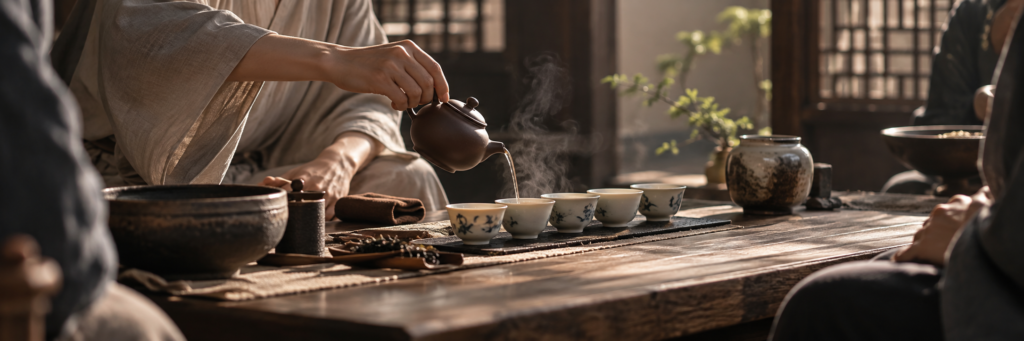
A wine experience may unfold through opening, breathing, observing, smelling, tasting and pairing. The bottle becomes part of a conversation, a meal or an evening, and its layers are gradually opened outward. A Gongfu tea session follows another rhythm: heat the water, warm the vessels, add the leaves, brew briefly, pour, smell, taste, then return to the same leaves again. The movement is circular rather than linear.
With each infusion, the tea changes, but so does the drinker’s pace. The hands repeat familiar actions. Conversation may become less urgent, and silence no longer feels like a gap that needs to be filled. A useful comparison is that wine can feel like a conversation opening layer by layer, while Chinese tea can feel like returning to the same sentence until something quieter becomes noticeable.
This is also why the many gestures of a tea session should not be reduced to performance. Pouring, warming, waiting and brewing repeatedly give the hands something precise to do. The ritual narrows attention without demanding that the mind become blank.
04
Opening and gathering are different experiences
The social power of wine is easy to understand. A good bottle can soften formality, warm a room and make conversation flow more easily. It can mark celebration, hospitality and shared enjoyment, and none of this requires excess. Chinese tea often works differently. Rather than increasing the energy of a gathering, it can create room for that energy to settle.
A tea table does not require constant speech. The act of brewing already gives the group a rhythm, so pauses feel natural. That distinction becomes especially relevant for people whose daily lives already involve a great deal of outward attention: meetings, decisions, presentations, messages, networking and constant response. For them, the value of another social experience may not be that it makes the room more animated. It may be that, for a while, nobody needs to animate it.
This is where Chinese tea can become more than a refined beverage. Its value lies partly in being given permission to remain with water, leaves, breath and time without needing to produce anything else.

05
Taste can also become a way of noticing state
Wine can cultivate sensitivity. A person learns to notice differences that once seemed invisible: acidity, tannin, fruit, age, balance and finish. Chinese tea can cultivate a similar refinement, but traditional tea practice often carries the question into bodily experience.
After several infusions, is the mouth dry or refreshed? Has the breath become hurried or easier? Is the body more restless or more settled? Has conversation become more forced, or less necessary? This is where ideas such as Qi enter traditional descriptions of tea.
Qi should not be treated here as a vague claim that tea contains some mysterious force. In this context, it is more useful to understand it as part of a traditional language for noticing how the body feels and changes during the experience: whether sensation rises, settles, opens, tightens or disperses. The practical point is simple. A tea session is not judged only by aroma or flavour; the state it leaves behind can matter too.
Wine often helps an occasion expand. Tea can create conditions for attention to gather.
This makes tea particularly interesting within a broader practice of self-cultivation. Attention is directed not only toward the object being tasted, but toward the relationship between taste, breath, posture, pace and mental state.
06
At a glance
| Western Wine | Chinese Tea | |
|---|---|---|
| Primary map | Terroir, vintage, grape, ageing, pairing | Mountain, season, processing, water, brewing |
| Typical focus | Aroma, structure, flavour, atmosphere | Aroma, texture, repetition, bodily state |
| Social direction | Often opens conversation and atmosphere | Often creates space for settling and pause |
| Common rhythm | Open, taste, pair, share | Brew, pour, taste, repeat |
| What attention follows | What unfolds in the glass and gathering | What changes in the cup and the drinker |
| Often cultivates | Taste, appreciation and shared experience | Taste, patience, steadiness and gathered attention |
Wine and Chinese tea can both teach people to slow down and pay attention. The difference is not that one belongs to the senses and the other to self-cultivation. Both can involve taste, ritual, hospitality and presence.
The difference is more subtle. Wine often asks how fully an experience can be opened and shared. Chinese tea can also ask what happens when the experience is allowed to settle, not only in the cup but in the person holding it. That is why a tea table can feel quiet without feeling empty.
Sometimes the experience is not becoming smaller; it is becoming more gathered.